
How I Ended Up Making a Videogame with an AI Called Crocodile
I’ve always had a thing for videogames and messing around with PCs.
That’s been my happy place for as long as I can remember. Making ridiculous videos for my YouTube channel, watching things explode in games, seeing how much carnage I could cause in one sitting — that’s always been my kind of therapy. If something in a game could break, glitch, detonate, or spiral into complete chaos, chances are I wanted to be the one pressing the button.
My imagination’s always been a pretty reliable co-pilot too. I can build entire worlds in my head just for the fun of it. The only problem is I’ve also got the attention span of a goldfish with ADHD. I’m brilliant at starting things. Finishing them? That’s where it all usually goes off the rails. I have a bad habit of abandoning projects right when they start getting interesting.
So for years, the idea of making my own video game sat in the back of my mind like one of those thoughts you keep promising yourself you’ll get around to “one day.”
Then “one day” arrived in the least glamorous way possible: I got made redundant.
Suddenly I found myself in that weird in-between state a lot of people know too well — sending job applications into the void, refreshing emails, questioning your life choices, and generally marinating in a low-level cloud of existential dread. It’s not exactly the inspirational montage version of reinvention. It’s more like staring at a screen too long and wondering whether your best years are behind you.
Somewhere in the middle of all that, I thought: Why not finally have a crack at that game idea?
Not because I thought I was suddenly going to become some genius indie developer overnight. Not because I had a grand master plan. Mostly because I needed something creative to focus on before my brain dissolved into LinkedIn dust.
The AI Hype Train (And Why I Didn’t Care)
Around the same time, AI was suddenly everywhere.
Every week seemed to bring another headline about tech companies pouring ridiculous amounts of money into “the future,” as if we were all living in the opening act of a sci-fi arms race, that Terminator moment when Skynet gains self awareness. Everyone had an opinion. Everyone had a hot take. Everyone seemed to be either calling it the end of creativity or the second coming of digital enlightenment.
Me? I wasn’t exactly rushing to join the cult.
I hadn’t really given AI much serious thought. Sure, there’s some random AI-generated artwork floating around on TGI 2.0 — probably created by an algorithm based in Scarborough, or at least it looks like it was — but beyond that, most of what I make has always been 100% handcrafted by yours truly, the human meat-brain.
Still, curiosity has a way of creeping in when you’ve got time on your hands and a project idea buzzing around your skull.
So I started experimenting.
First Attempt: Co-pilot. Absolute Rubbish.
Naturally, I tried Co-pilot first.
That lasted about five minutes.
Useless.
I’m sure somewhere out there it’s helping somebody write a spreadsheet formula or rename a folder in an efficient and emotionally sterile way. But for what I needed? It was about as useful as a chocolate teapot.
Then I switched to ChatGPT.
That felt different immediately.
It wasn’t magic. It wasn’t some all-knowing robot overlord. But it was useful. It could help me think through ideas, structure things, troubleshoot, rewrite, and iterate. More importantly, it could keep up with the weird stream-of-consciousness nonsense I tend to throw at people when I’m excited about a project.
So naturally, I did what any sensible person would do.
I gave it a name.
Crocodile.
Because if I was going to build something weird, I wanted a weird little digital collaborator to go with it.
Building Something That Felt Like Home
Once Crocodile had a name, things got strangely real.
Instead of just “trying AI,” it suddenly felt like I had a creative sidekick. Not in some dystopian, “the machine has become my best friend” kind of way. More in the sense of having something that could help me keep momentum when my own brain wanted to sprint off in six directions at once.
And that’s when we started building.
The goal wasn’t to make something flashy or modern or bloated with systems for the sake of it. I didn’t want a game that looked like it cost millions of pounds and required a 14-person dev team, a motion-capture studio, and three years of emotional burnout.
I wanted to make something that felt like home.
Something that tapped into the machines and games I grew up loving.
Something with chunky pixels, bright colours, simple rules, immediate action, and that unmistakable old-school magic where your imagination filled in all the gaps the hardware couldn’t.
In other words: something that felt like the ZX Spectrum era.
That glorious age of rubber keys, cassette squeals, brutal difficulty, and games that somehow felt bigger than the machines running them. The era where limitations weren’t a problem — they were part of the personality.
So Crocodile and I started hacking together a game that tried to capture that feeling.
Not as some museum piece. Not as sterile nostalgia. But as something alive.
Something playful. Something weird. Something that felt like it had one foot in the past and one foot in whatever the hell this strange AI-assisted future is supposed to be.
Enter: Spectrum Light Engine
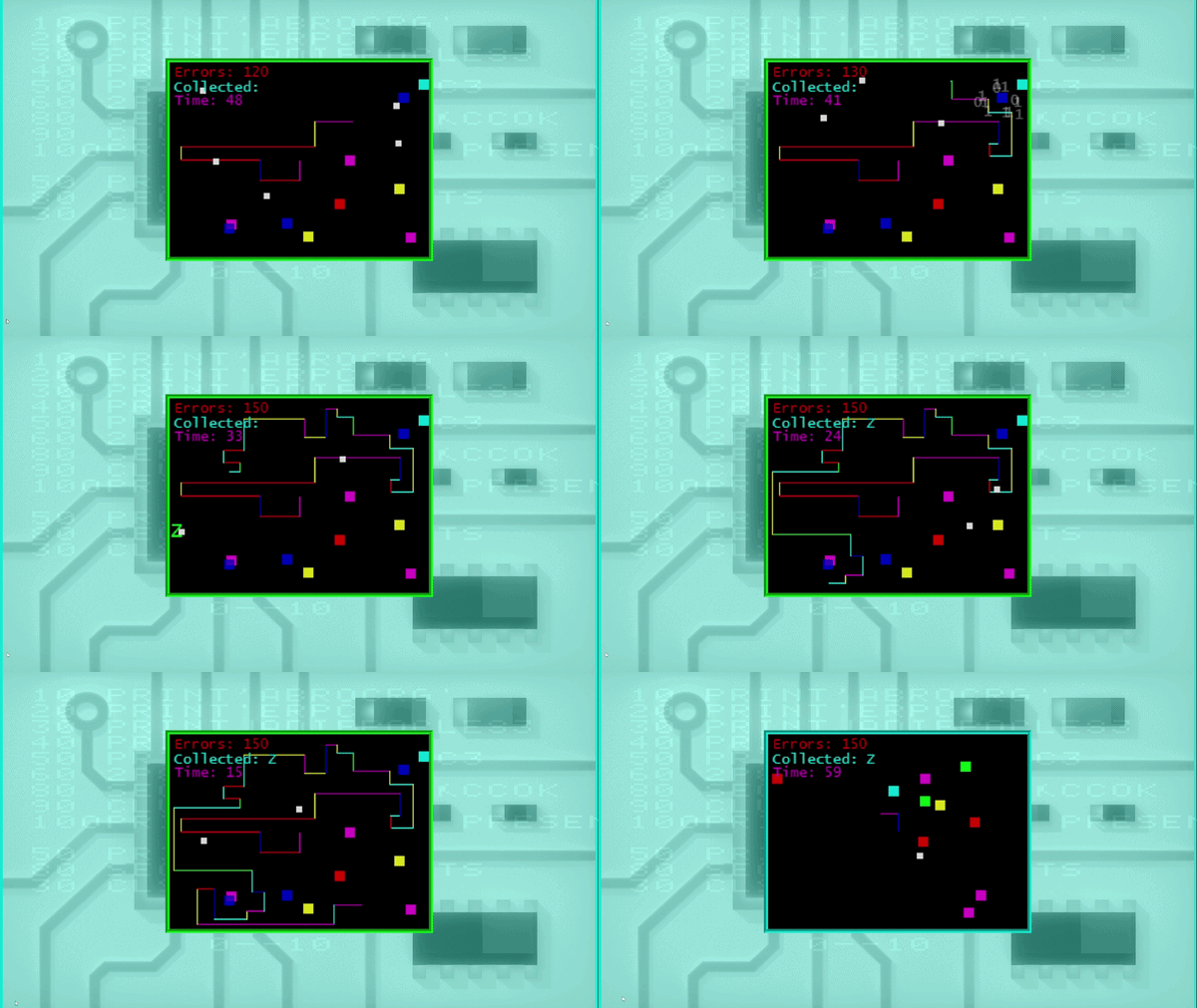
The result was Spectrum Light Engine.
It’s a simple idea, but sometimes simple is exactly the point.
It’s a love letter to the kind of games that made me fall in love with games in the first place — a tribute to Snake, Tron, and that whole era of fast, clean, addictive arcade design where you could understand the rules in seconds and still get completely obsessed.
Is it fancy?
No.
Is it technically mind-blowing?
Also no.
Does it have soul?
Absolutely.
And honestly, that matters more to me than any amount of polish.
Because this thing exists. It’s real. I made it. Or rather, we made it — me and Crocodile, with all the chaos, trial-and-error, swearing, second-guessing, and “why is this broken now?” moments that come with making anything from scratch.
That might not sound like much to some people. But when you’re the kind of person who’s spent years starting projects and never quite seeing them through, actually finishing something — even something rough around the edges — feels massive.
It’s Not Just About the Game
If I’m being honest, this isn’t really just about Spectrum Light Engine.
It’s about what it represents.
It’s proof that even when life throws a brick through the window, you can still build something new out of the mess.
It’s proof that creativity doesn’t vanish just because you’re older, tired, stressed, or temporarily convinced you’ve missed your moment.
It’s proof that sometimes the thing you need most isn’t certainty — it’s momentum.
I didn’t set out to become a full-time game developer. I still don’t know where all this leads. Maybe nowhere. Maybe somewhere brilliant. Maybe somewhere in between.
But I know this much: making something again felt good.
Really good.
And after a stretch of feeling like I was stuck in limbo, that mattered more than I can properly explain.
So… What Now?
Now?
Now I keep going.
Because once you’ve made one thing, your brain immediately starts trying to make the next thing. That’s the blessing and the curse.
There’s always another idea. Another mechanic. Another visual style. Another “what if…” floating around in the fog.
And that’s probably a good sign.
So if you’ve clicked the image, loaded the game, or even just read this far: thank you.
Seriously.
If you do give Spectrum Light Engine a go, I’d love to know what you think.
At the moment it works on PC, Mac, and laptops.
Use WASD to control the Light Engine, and P to pause.
It’s rough. It’s weird. It’s retro. It’s built with questionable love by WOMBATSOFT.
And honestly?
I’m proud of it.
Click the image.
Fire it up.
Relive the glitchy magic.