
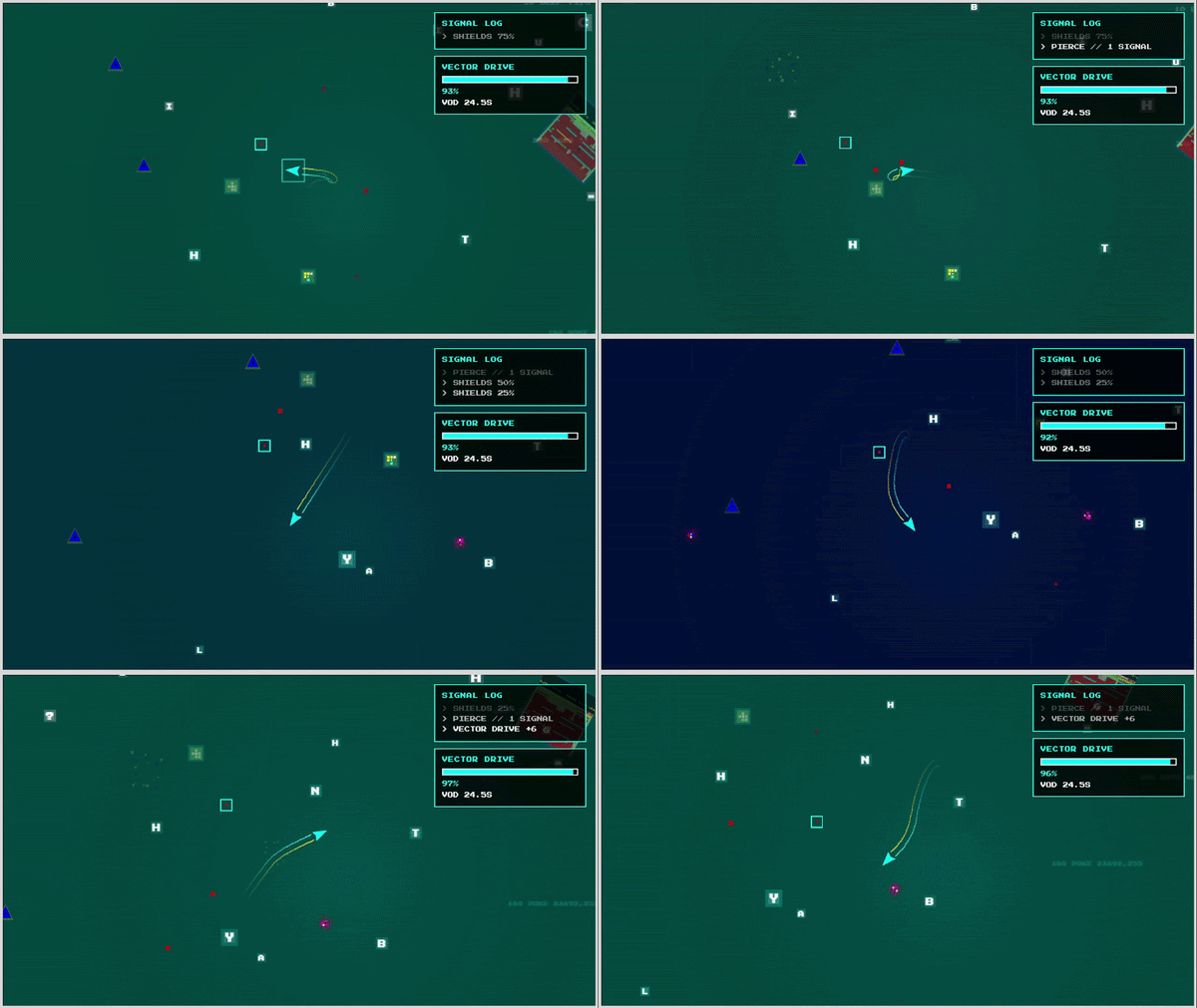
ZX Verse Dev Update — SIGMORION (V1.2)
This latest build marks a major shift in how the world behaves and responds. What began as simple visuals and interactions has evolved into a layered system where each element has a distinct role and meaning.
Core Interaction Layers
The game now operates on three different interaction types:
Touch (Letters) — restore the archive
Laser (Corrupt Blocks) — rupture and extract
Laser (Drifters) — disturb, not destroy
Each system now behaves differently, reinforcing the idea that the player is interacting with a signal environment rather than just shooting targets.
Charge Laser Overhaul
The charge laser has been significantly expanded:
- Cyan beam with a tapered scanline aesthetic
- Tuned thickness and charge sweet spot
- Pierces through multiple anomalies
- Separate interaction logic depending on what it hits
Corrupt blocks can be destroyed, while drifters react instead of breaking.
Archive Drifters
Drifters are no longer passive visuals.
They now:
- React to the laser with glitch effects
- Emit particles when disturbed
- Can be physically displaced
Importantly, displacement is now permanent. Drifters continue their motion patterns, but from a new position. This makes them feel like unstable archive echoes rather than objects.
Magnetic Letter System
Letters now behave like signal fragments rather than static pickups.
- They attract toward the player at mid-range
- Repel slightly when too close
- Exhibit subtle motion while interacting
- Flow naturally into collection
This creates a field-based interaction instead of simple collision.
Background System Evolution
The background has been completely reworked.
Removed:
- Large filled background blocks
- Screen-locked visual layers
Added:
- World-space signal geometry
- Orthogonal line structures (horizontal and vertical only)
- Stable but randomly generated layouts per zone
- Subtle thickness variation for depth
The background now exists in the same space as gameplay. The player moves through it, rather than it sitting behind everything.
Interface & Signal Feedback
The interface has begun to respond more directly to player input.
Hidden inputs can now trigger subtle changes in the system display, reinforcing the idea that the archive can be interpreted as well as interacted with.
Audio feedback has also been introduced, with distinct tones tied to different system states.
Technical Improvements
- Fixed background lock issue that caused black screens
- Stabilized zone-based background transitions
- Converted visual elements to world-space coordinates
- Added recycling and spawning for continuous environment density
Design Direction
The game is no longer behaving like a traditional shooter.
It is moving toward a system where the player:
- restores
- disrupts
- observes
Different elements respond in different ways, and the meaning of interaction depends on context.
Next Steps
Future work will expand on these systems with:
- more complex drifter reactions
- signal traces that hint at hidden structures
- deeper integration of foreign system artifacts
This build represents a shift from visual effects to a consistent interaction language.